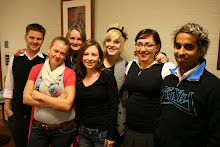
i sit here in the internet cafe, filled with a huge sense of pride, gratitude and achievement. Friday afternoon concluded the first ever Edmund Rice Camp for Kids in Kenya, and it couldn't have been more of a success. As a group, we are immensely proud of how the camp went and we are able to see our impact on the fantastic camp programme, the dedicated and wonderful East African youth leaders, and most importantly on the kids themselves.
The roles we played in this camp were varied and began long before this previous week. After Kel attended the Karibu Conference last year, she was inspired to bring the awesome work Edmund Rice Camps for Kids WA to Kibera, a place of intense poverty. Over the course of 2008, Kel shared her vision with the group as we prepared to run this project as part of our immersion. In perth, we all fundraised like mad to raise the money to fund this camp (and the one in Tanzania in the first week) and looking back at what a success it was we want to thank our friends and family again for their support. We have been able to witness first hand the result of your generosity through support and donations.
Once in Africa, we also met with the group of East African youth volunteers several times over the first two weeks for leader training, a sharing of games and songs, brainstorming and constructing the camp programme, discussing expectations and aims for the camp, and also an exchange of our cultures in order to maximise all volunteers' interactions with the kids. This part of the project was equally as important as the camp itself as we were able to impart our ideas and experience onto the East African leaders in order to prepare them for the potential next Kibera camp which they will run by themselves.
On the camp, we were given different leadership roles to best facilitate both the smooth execution of the programme and also the East African's development of leadership. we tried at all times to give the best support to the African leaders and let them take ownership of the camp, because the plan is that they will continue with this initiative. after working with them for the week, i am left with every faith and confidence that they will keep the camps going to the same level of success. the East African leaders were an absolute inspiration. most of them live in the Kibera slum themselves, but take pride in their tiny houses and are so welcoming and hospitable. most are unemployed and without an income so they were giving up time that would've been spent looking for work to be on camp and playing with the kids. they are so open about their life stories, most shaken with unimaginable tragedy and misfortune, and despite it all are filled with positivity and passion and a thirst to achieve ultimate goodness.they have so little and give so much. i am moved and inspired by their work. we have also been lucky enough to call these amazing people our friends as they have welcomed us into their beautiful country.
the camp itself was an incredible experience. the first thing we noticed was the difference in the kids' behaviour than that of the Tanzania camp. it seemed that the Tanzanian children were the gentle country folk who were so excited by our mere company. the kids in Kibera however, were like the city kids from the ghetto. it was going to take more than a little smile to create a connection with these kids. after the first day, however, the kids had warmed to the bunch of wazungus (white people) and we realised that a tough exterior was purely, well, a tough exterior.
something that was really interesting throughout the whole camp was the notion of communication between us and the kids. they knew minimal english, and with only the basics of kiswahili mastered we thought it was going to be a lot harder than it was. turns out, every kid in every country speaks the language of "play" and we were able to bond with the kids in that way. whether it be through singing songs, playing the jembe drum, making a friendship bracelet, playing chasey, sharing a meal, dancing together or kicking a ball, we found all kids have the same desire for fun and affection, and we were able to make connections that way.
there was one very small girl on camp who was a particular favourite of our group who we individually shared so much with and felt very fond of. During our final debrief and reflection on sunday, we all collectively realised that this small girl hadn't spoken a single word to any of us. it hadn't even occurred to me that i hadn't had a conversation with this girl because i felt like i knew her, and that i had a connection with her beyond a smile and a wave. i guess there is so much more to communication and endearment than words.
the camp programme involved sports activities, kite-making, paper-plane competitions, story-telling, games with hoops and balls and skipping ropes, poetry, warm-fuzzy writing, and singing and dancing. the best part about the programme was the way every kid gave their complete energy and attention to every activity. they were so enthusiastic and thrilled by every activity that was run. something that we've noticed Kenyans always talking about it "energy" and "being energised" as part of being alive, and the kids were constantly encouraged to be full of energy. and they always were!
by the end of camp, we all realised that kids are the same no matter where you are. once a few flimsy barriers are broken down then the friendship, lessons and connections that can be shared with a child is not affected by nationality, age, race, culture, gender or class. it didn't matter that i was a big white female "grown-up" and he was a tiny black african boy, because once all those physical labels are taken away, all that is left are two simple people who pretty much just want to laugh and play.
Sally
Sunday, December 21, 2008

Carnivore
Once camp was over and the end of the immersion was upon us, we had our celebration dinner at Carnivore Restaurant on Saturday night. It is a highly popular place, the venue is enormous, the building and decor is Safari style. The waiters dressed in in their matching Safari outfits constantly come to the table and slice the meat straight off huge metal skewers with a machete on to your hot plate. On the menu was chicken liver, chicken gizzards, ostrich meat balls, the list goes on... it is possible on some occasions to be offered elephant, giraffe and zebra... so I was told. I was amazed, fascinated and really impressed with the place... even though I am vegetarian. There are alternatives for us leaf eaters... however as my motto goes 'When in Africa...' inspired me to taste the tiniest sample of crocodile which tasted like fish. So if you are planning on visiting Kenya, I would highly recommend dropping in to Carnivore!
Kellee
Kellee
Tuesday, December 16, 2008
More on food... beans means....
I have the pleasure of having the role of kitchen hand on camp and therefore are privy to all the food preparations.The food is amazing but very different to that back home- those things that are similar are prepared in very different ways.Until now i thought that chicken just came as a wing or breast from KFC but now i know how to prepare,cut through the bones and cook all of it from the liver to the neck mmmm chicken...Peeling a potato with a knife was also interesting and i am pleased to say that i finished the job with all my fingers..well just-i found it so hard that the next day we bought a peeler for the camp.But i am constantly amazed at how hygienic our little make shift kitchen is- the cordial containers are cleaned after each batch mmmm a hint for us back in WA and the pots scrubbed until every little thing is off (at times this can take weak little me over 1/2 hour just to clean one large pot!!)..I also am loving the differing types of food from ugali, chapatis,scummawiki,potatoes and bananas but one thing we are partial too is any more beans.....
Kellie
Kellie
Matatus!!!
Hi everyone. I thought I'd let you all in on one of the truly great Kenyan experiences... the matatu. Matatus are the staple mode of public transport - they're minivans (Toyota Hi-ace or Tarago or such) that are pimped out to the max and have blaring hip-hop or reggae (some even with glowlights & little LCD screens showing some interesting videoclips) and take people all over the city.
Most are full to the brim - packed with 16-17 people in each rattling along at some fairly quick speeds. And who needs road rules anyway? Certainly not these guys... every possible law is broken on a regular basis.
Now this might all sound pretty worrying or scary, but it's hilarious (well, to me anyway). The first couple of trips were a bit stressful but as you get used to them you learn to just hang onto something and enjoy the ride. The non-verbal communiction between driver, money-man and passengers is also interesting to navigate your way through.
If you're ever over this way, you must give the humble matatu your respect and your dedication. You'll love it! :-)
See you soon
Jonno
Monday, December 15, 2008
Mass
Jambo!
so on Saturday we had a lovely relaxing picnic in Uhura gardens with members of the local church youth group, some of which are leaders of the camp, we played more get to know you games and enjoyed the best lunch (love chapati!). We organised our places and duties for the mass the following day, some of us were dancing while others sang and prepared a speech. So Sunday we all put on our best clothes and met an hour early to rehearse, now I have never been to church before so my first time was actually pretty amazing, we danced along to some very beautiful swahili singing. The church was very nice and full! The priest welcomed us "Australian Visitors" many times and had some interesting stories to tell, and at the end Jonothan and Kellee gave a great speech about what exactly we are doing here in Kenya (not just visiting).
Now we are pupmed to start our week of camp, the first ERC Camp in Kenya!!!
Kwaheri!
Saturday, December 13, 2008
Kenyan History
A couple of days ago, Br Ignatius and Samuel, who is a teacher visited us and presented a wealth of information on the history, politics and culture in Kenya. The session was very educational and interesting. We asked many questions and I found myself making comparisons with Australia. I was most fascinated by the cultural traditions of tribal groups still practiced today and the role of women in society.
Yesterday, at the conclusion of our orientation to the Kibera slum, our guides gave an impromptu talk on the violence that followed the political unrest in the region last year. This account was more powerful from the previous presentation. Standing on a hill, looking down at the area they explained what daily life was like for them at that time... this was very tangible and confronting. People were forced from their homes, there was fighting, houses were torched, children and mothers were assaulted and there was daily gun fire - this lasted two months. Our guides at this time, whilst from different tribes, still got along and attended the Edmund Rice Centre to volunteer their time for the youth.
...very challenging to process...
Kellee
our day in kibera
Jambo na karibu Rafikis!
After month of preparation in perth, and 12days experience in Kenya, we ventured yesterday into the Kibera slum. we were accompanied by our guides and new friends from the Edmund Rice centre, most of whom actually live in the slum.
it was an intense, confronting and challenging experience. Home to between 1 and 3 million people, Kibera is a maze of tiny clay huts with corrugated iron rooftops, separated by undulating paths of rocks and holes and dirty streams of water. there were people, mostly children, everywhere.
i was overwhelmed by the squallor,filth and deep sense of pride and community that emanated from the clutter of houses.
as we travelled to the sounds of children chanting "howareyou! howareyou!", i wished i could've lifted my eyes from my precarious footwork, as there was so much to take in. it was like being in a completely different world. we all felt lucky that we had been given such extensive preparation in the forms of research, formation meetings discussing culture and risk management, because without that grounding and prior expectations, i think we would've struggled a significant amount more.
in small groups, we visited different areas of the slum, including orphanages, schools, homes of people bedridden by HIV Aids, and homes of those living with the disease. in my group, we met a woman who is unlike anyone i've ever met before, but unfortunately is a common character in the Kibera Slum. Josephine lived in a house no bigger than a small bathroom, she had six children, two of which had been taken away to boarding school, and the other four being under the age of ten. she also cared for her 17yr old niece who contracted HIV the previous year, and had come to live with her in order to get access to the freely distributed AntiRetroVirals in Kibera. Her niece had a son who was also positive, but was taken away to a hospital so he could recieve necessary care. While her Husband was unemployed and spent the day sleeping, she looked after all the children, did the cooking and cleaning, went to the forest to illegally chop firewood, carry it all the way back and then take it to market to sell. after we left, our guides told us that if she did not have dinner prepared for her husband every night, he would beat her.
it is a terrible fact that this is not a unique situation. sitting in her tiny house and hearing her story was an immensely challenging and almost harrowing experience.
i never knew the meaning of hard work until that day.
That night, i was left reeling from the events of the day. such strong images kept flashing back into my head; a half-naked toddler crying alone on the railway tracks, women washing clothes in buckets on the street, the big, welcoming smiles of members of the community, climbing up rocky alleyways carefully not falling in rubbish. the camp we will begin on Monday will be tough, but i am so looking forward to it. i believe we are able to embark on this camp experience with a greater depth of understanding because of the immersion process we have participated in over the past 12 days and previous months, and especially by experiencing first-hand the conditions in which these people live.
kwaheri
Sally
Subscribe to:
Posts (Atom)